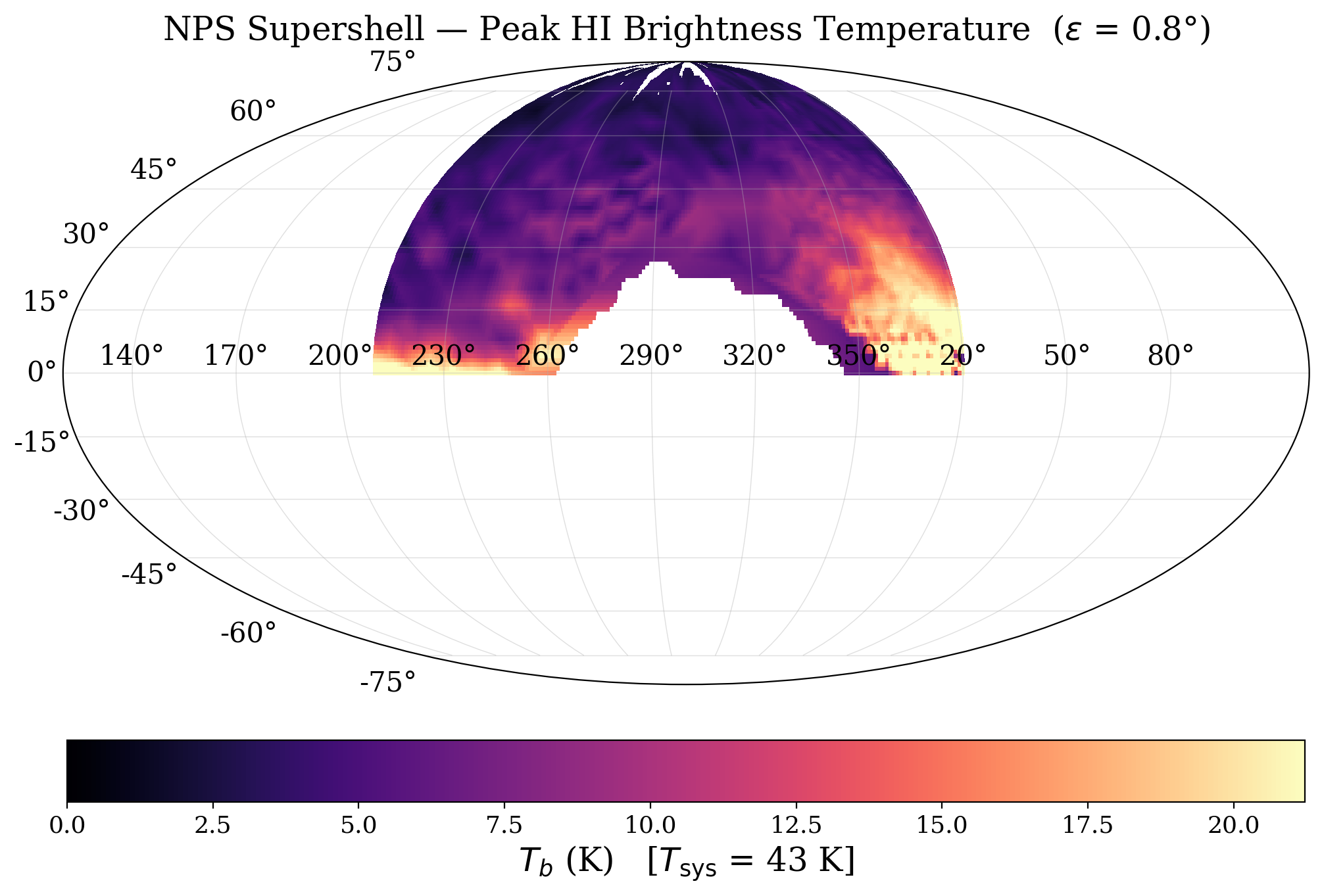
A 21-cm neutral-hydrogen survey of the North Polar Spur supershell with the 4.5-m Leuschner dish (1420.4 MHz), covering Galactic longitudes ℓ = 210°–20° and latitudes b = 0°–90° across 1170 pointings over two sessions. A Raspberry-Pi / ugradio stack drove an SDR spectrometer (2.4 MHz band, 1024 channels → Δv ≈ 0.12 km/s, 4° beam) with frequency switching at 10 s per state, producing an (ℓ, b, v) data cube for morphology, kinematics, and mass.
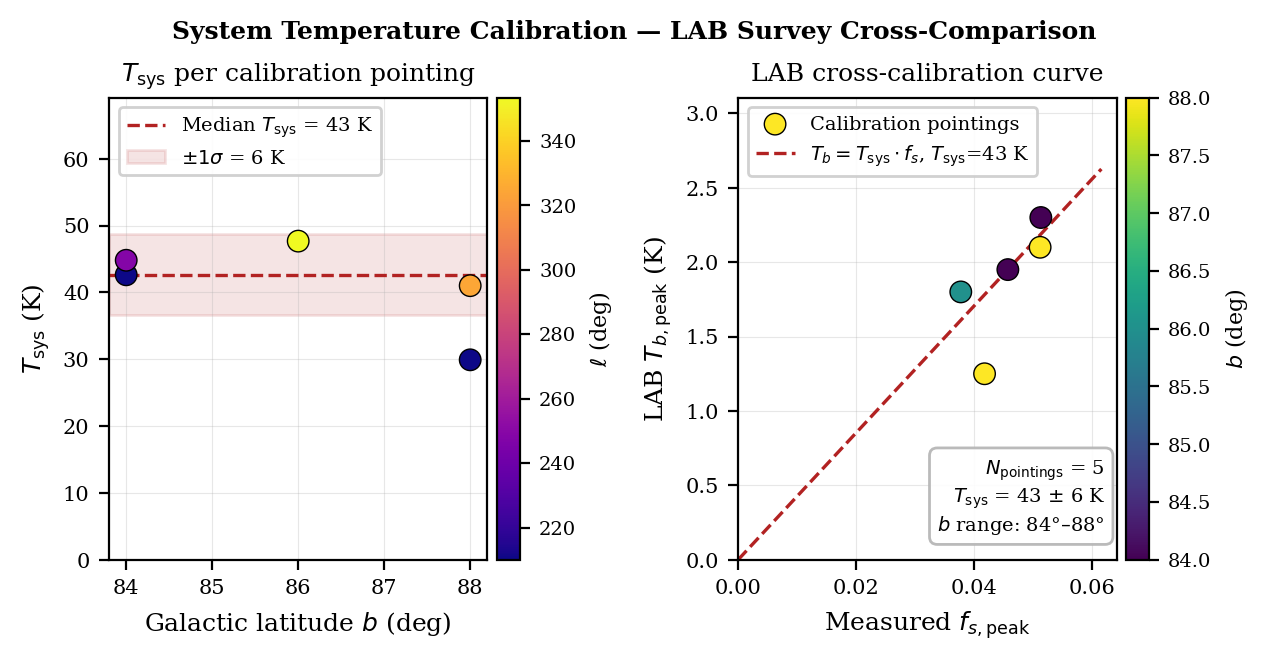
Dual-polarization spectra were averaged, bandpass-flattened by frequency switching, and RFI-cleaned in four stages, then absolutely calibrated against the Leiden–Argentine–Bonn (LAB) survey at five high-latitude pointings, giving a system temperature Tsys = 43 ± 6 K (radiometer noise ΔTrms ≈ 1.2 K).
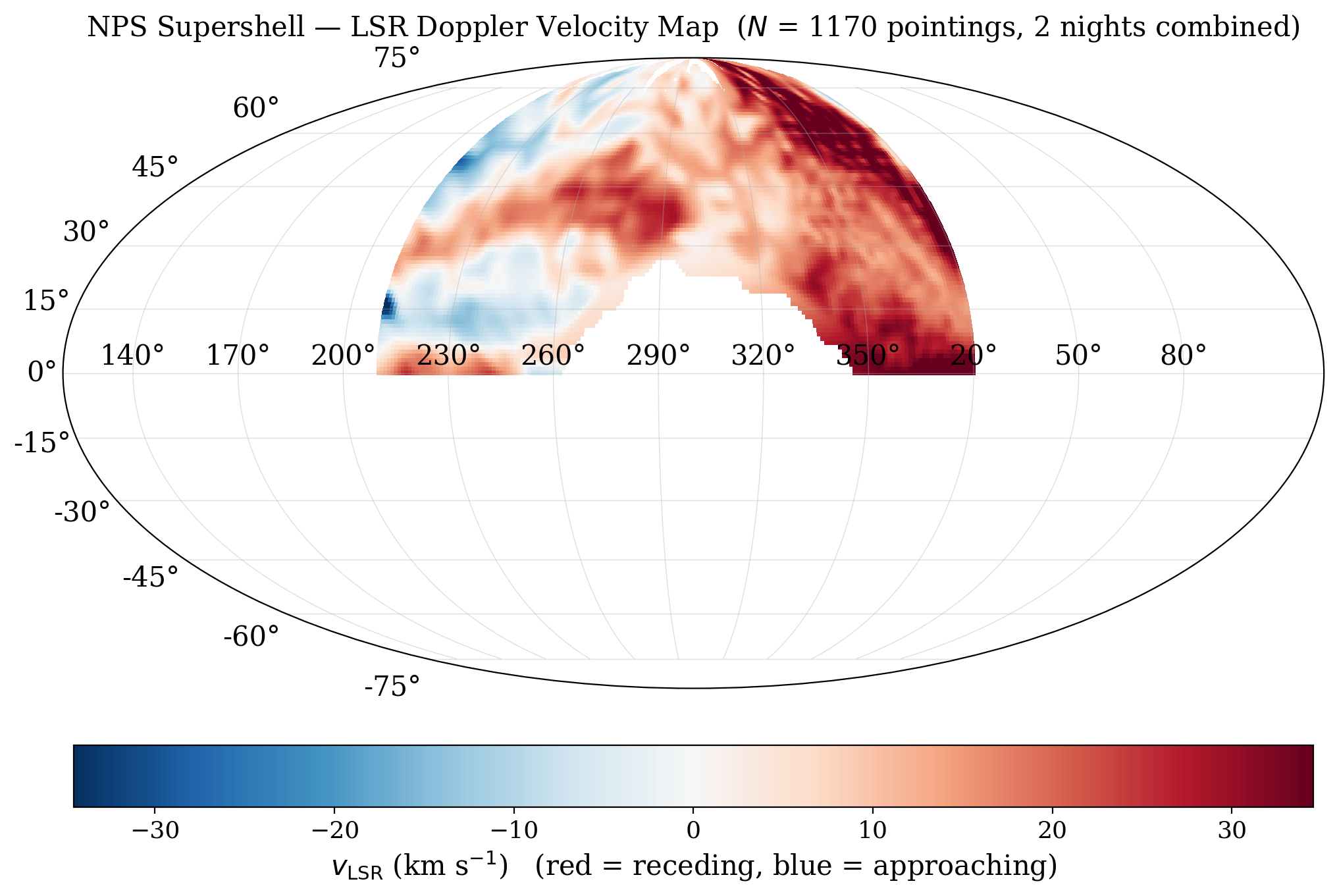
Intensity-weighted LSR velocity centroids span −45.3 to +61.0 km/s: a coherent +10 to +35 km/s redshift traces the receding far wall along the main arc, while blueshifts near ℓ ≈ 210°–230° trace the approaching near wall. After removing ~10–15 km/s of Galactic rotation, this implies a shell expansion velocity Vexp ≈ 20–30 km/s.
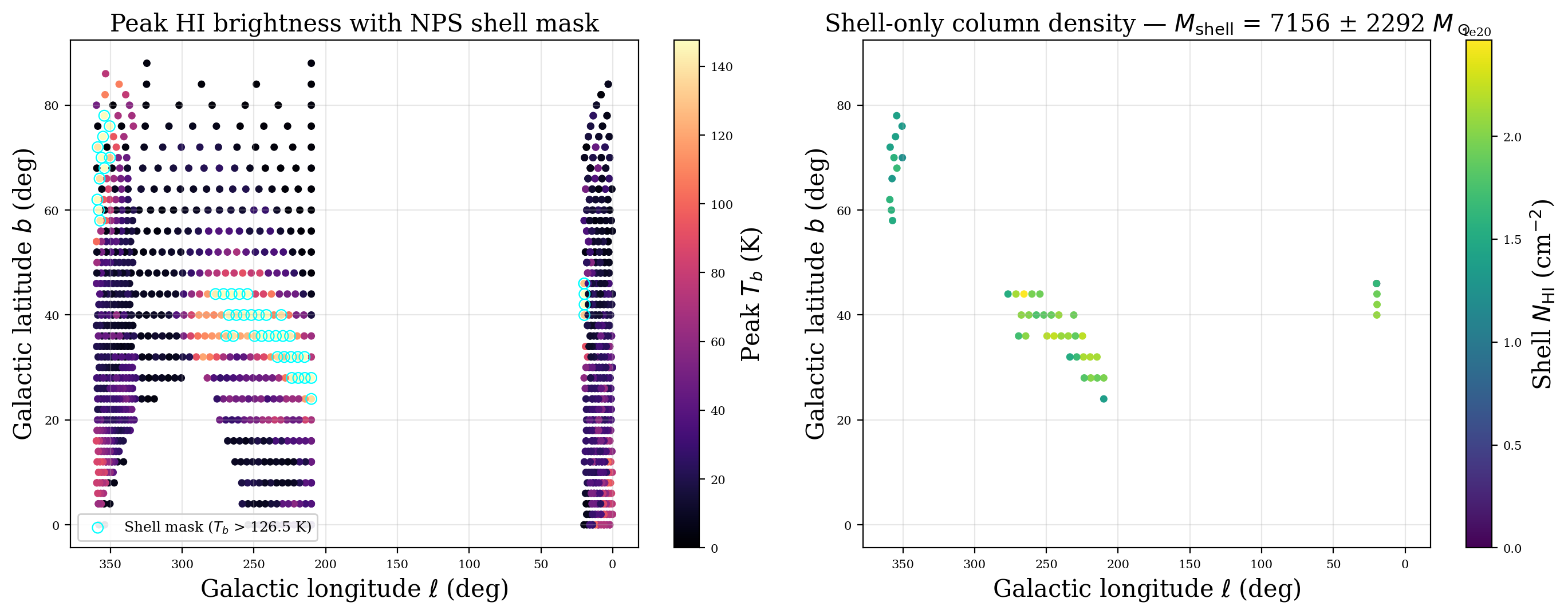
Applying the Berkhuijsen et al. (1971) geometric annulus (30°–58° from the Loop I center) selected 665 pointings; a 2σ brightness cut at Tb > 12.86 K above a 5.80 ± 3.53 K foreground isolated 209 shell-wall pointings. Summing the excess column density (median NHI = 1.82×10¹⁹ cm⁻²) gave a shell HI mass Mshell = 9,124 ± 2,741 M☉ at D = 140 pc, bracketed 4,655–18,620 M☉ over 100–200 pc.
The mass is dominated by systematics, beam solid angle (±25%, since Ω ∝ θ²) and Tsys calibration (±20%), with statistical radiometer noise under 1%. The ~6× excess over the canonical Heiles (1998) ~1,500 M☉ is accounted for by D² distance scaling, a broader shell annulus, and residual foreground contamination, motivating denser sampling and full 3-D shell modeling.