UC Berkeley undergraduate research in RF collection and analysis. Two X-band dishes on the roof of New Campbell Hall feed a two-stage downconversion chain (LO 8.75 GHz → intermediate frequency, then 1.54 GHz → baseband) into a SNAP-board FX correlator that computes 1024-channel cross-power spectra, each averaged over 305,200 spectra (~1.25 s integration). The Sun was tracked across a full 12-hour transit on 8 April 2026 to recover its angular size directly from the fringe data.
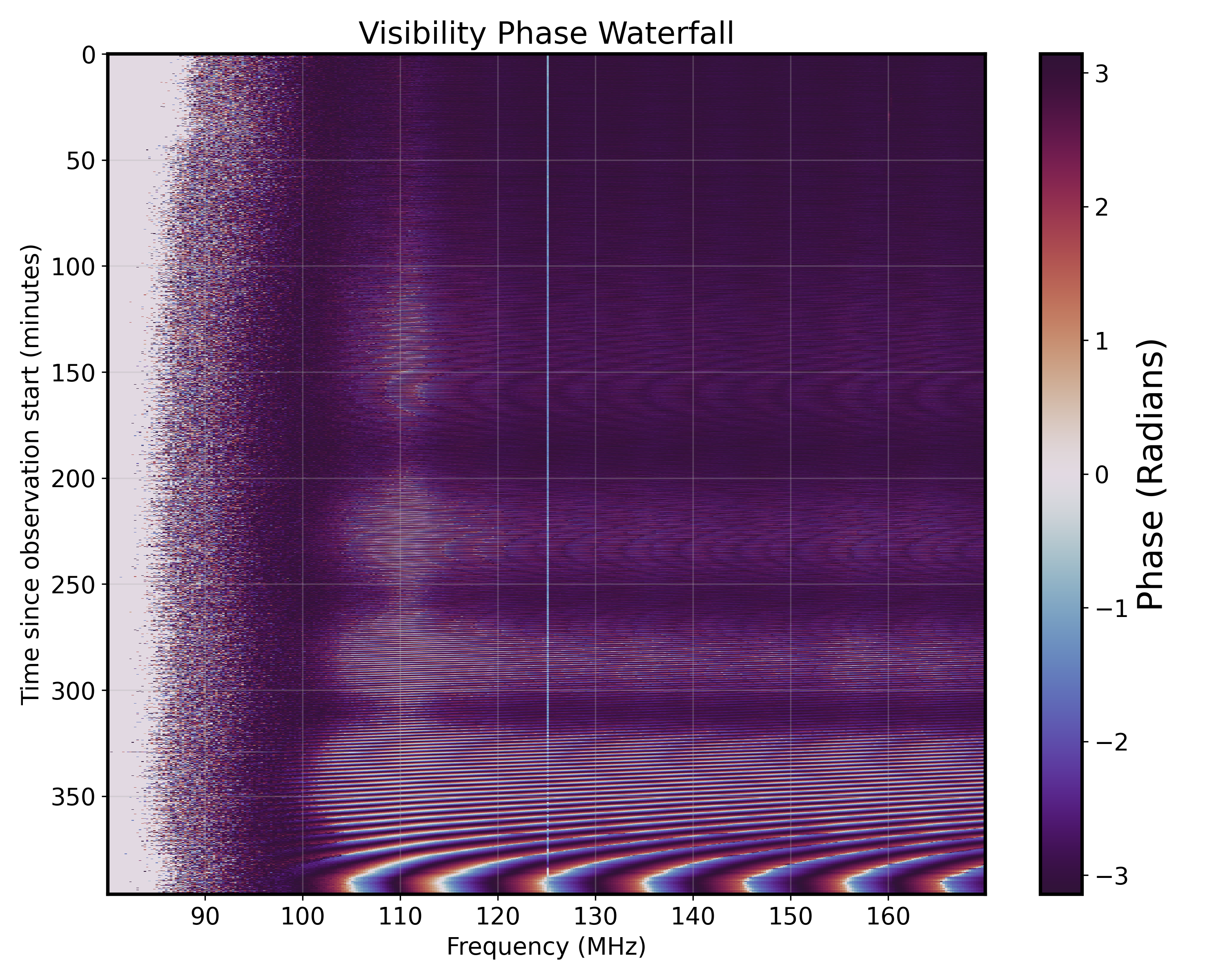
Because the baseline sits inside the fringe’s trigonometric argument, it was recovered with a two-stage non-linear least-squares fit, a brute-force grid search seeded from a ~14.6 m tape estimate, then refined by an iterative Taylor/Jacobian (χ²-gradient) solver whose covariance matrix set the uncertainties. This yielded an East–West baseline bew = 14.56 ± 0.025 m and bns = −0.014 ± 0.051 m, the electronic baseline between the two dishes’ phase centers.
The true signal sits at a predictable local fringe frequency, so an FFT bandpass centered there (then an inverse FFT) stripped broadband noise and recovered clean quadrature fringes, Real and Imaginary components held 90° apart, across the full transit, exposing the slow amplitude envelope (the fringe modulator) imposed by the Sun’s finite angular width.
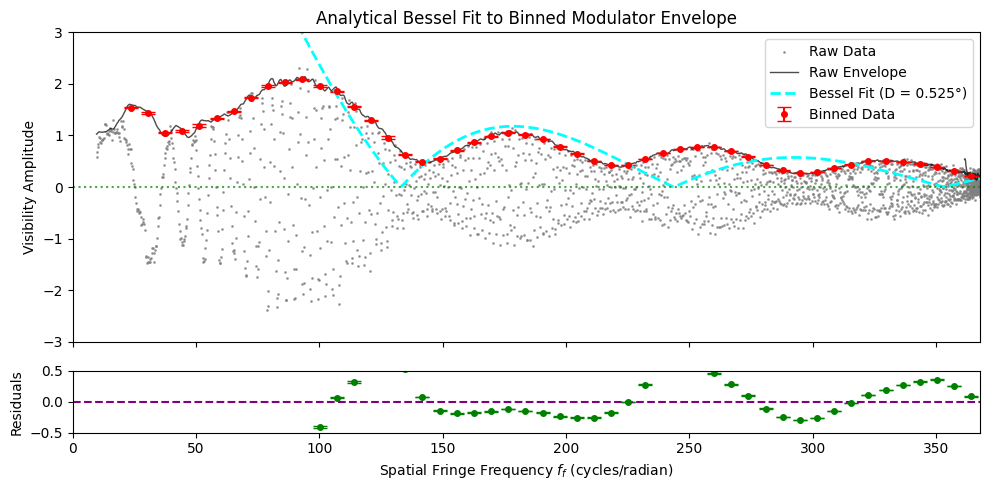
Treating the Sun as a 1-D uniform-brightness disk, whose Fourier transform is a first-order Bessel J₁(x)/x envelope, and locating the first null at fnull ≈ 138 Hz gave a solar angular radius R = 0.52 ± 0.015°, i.e. a full diameter of 31 arcminutes, within 3.125% of the accepted 32′, recovered against a meridian fringe resolution of just 7′.
The residual ~3% error is consistent with two second-order effects: solar limb brightening at centimeter wavelengths (the disk is not a perfect top-hat) and bandwidth smearing across the Δν ≈ 100 MHz band, where each channel sees a slightly different fringe spacing and averaging softens the zero-crossing.